
Legal texts
1. Introduction
1.1. Why is it important to us?
Mobile and digital products are obligated to inform users about their rights regarding data protection, cookie usage, privacy policies, and terms of use. However, since we provide airline services, we are required to deliver much more comprehensive legal texts to our users.
For Turkish Airlines; any topic referring to the rights of users, passengers, flights, ticketing, and transportation falls under the scope of legal texts.
As content designers, it is our responsibility to make these extensive rights more inclusive, accessible, readable, and scannable.
1.2. Can legal texts be shortened?
While shortening a legal text may not be possible, systems in different countries and regions around the world allow for it to improve user experience. In regions with more tolerant regulations, it is ideal to provide a summary of the text at the very top, displayed in a separate component, as a concise overview.
Another critical aspect is whether these summaries are considered a part of the full text or are merely informational. Many legal systems permit the use of summaries as long as they do not alter the full text.
In summary, if you are writing for Turkish Airlines, you can include a summary for better user experience, provided it does not change the full text and is approved by legal teams in the respective country or region.
1.3. How are legal texts categorized at THY?
- Legal Notice
- Terms of Use
- General Conditions of Carriage
- Conditions of Online Channels
- Privacy Notice
- Other Regulations (segmented by region, such as EU, USA, Israel, Taiwan, etc.)
- Passenger Rights
The simplifying factor for these legal texts lies, of course, with content designers. But how can we, as content designers, provide ease and clarity? Let’s dive in and explore.
2. Structure of legal texts
2.1. Provide plain-language summaries
By standardizing this structure, you not only adopt a fair design approach but also create a significantly more user-friendly experience.
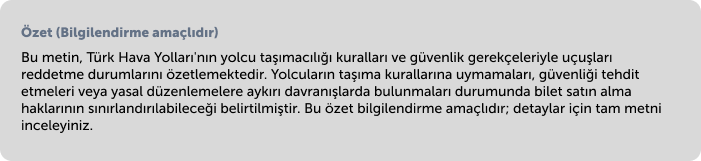
Imagine yourself as a user. You’ve navigated to a page to learn about your rights, only to encounter an endless block of text. How would you feel? You’d either give up or resort to searching for specific words. Summarizing the content and listing its main points in a separate component would provide immense ease of use.
As mentioned earlier, in legal systems that allow summarization, summaries created in consultation with legal experts and without altering the full text can greatly enhance the user experience.
Let’s take a look at a summary example for the Safe Travel Passenger Tracking System text.

2.2. Use bullet points or short paragraphs
Long sentences, complex wording, and linked phrases… Legal language is prone to misunderstandings. If legally permissible, recommend using short paragraphs and bullet points to simplify the text. Consult your legal experts on this approach.
2.3. Organize the content with clear and descriptive headings
Frequent use of headings and subheadings is essential for readability and a well-structured layout. Don’t hesitate to classify content and add subheadings—it’s the best way to make a complicated text understandable.
2.4. Ensure all sections are labeled intuitively
For example, labels like “Flight Cancellations and Delays” or “Luggage Compensation Rights” are crucial for user navigation. Proper labeling helps users quickly find the information they’re looking for.
2.5. Use expandable sections to have better interaction
Collapsible sections can break down long legal documents into manageable pieces. If it poses no legal concerns, this method improves readability and enhances the overall user experience. Expandable components are always a great addition to legal texts.
If it’s possible to integrate them legally, do without hesitation.
3. Hyperlinks
3.1. Contextual links
Avoid generic link text like “click here.” Instead, use descriptive texts whether the link is proper or common noun. If you’d like to mention a general topic in a sentence or a paragraph to direct users to a subpage, please use sentence case and common noun.
On the other hand, you’d like to direct the user a specific legal text. In that scenario, please use proper noun and title case to provide grammatical correction. You find the best practices below.
Read more about baggage policies.
I have read and accept the Terms of Use and Privacy Notice.
3.2. Inline links
Inline links are hyperlinks embedded within a sentence or paragraph. If a legal document is linked inline, it’s crucial to use proper nouns or common nouns appropriately. When linking to a detailed page about the topic, use a common noun. If directing users to the exact legal text, use a proper noun. Best practices for contextual links apply here as well.
4. Accessibility and inclusion in legal texts
4.1. Readable language
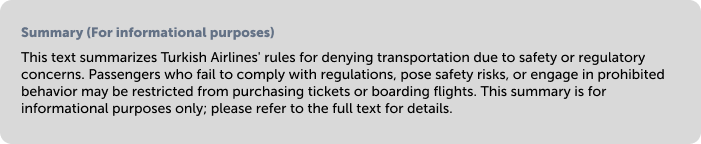
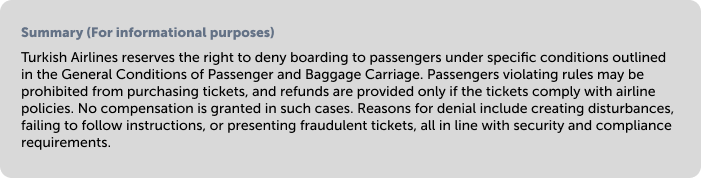
Write summaries in plain, accessible language for all user groups, including those with low literacy levels or non-native speakers. This ensures readability for individuals who are new to the language or not fully proficient. Please prioritize making summaries easy to read.
4.2. Multilingual support
Turkish Airlines’ multilingual and multicultural structure also applies to legal texts. Our web and mobile products are not only available in the language of the relevant country but also in other commonly spoken languages.
For instance, our Swiss page includes German, French, and Italian, along with Turkish and English. Legal texts created under
Swiss law are translated into all the service languages, provided the legal system permits such translations.
Content designers and translators play a crucial role here. Ensure that the texts are consistent and culturally appropriate.
For any requested changes, consult local legal advisors and make updates accordingly.
5. Guidance for content designers
5.1. Collaborate with legal teams and consultants
Collaboration with legal teams is a core responsibility of content designers. While legal teams are the subject matter experts, content designers specialize in the clarity and presentation of text in user interfaces.
To maximize efficiency, consider these tips:
- The accuracy of legal expressions is as critical as grammatical correctness. If you spot any typos or punctuation errors, report them to the legal team for correction.
- When writing for a country with a legal system that allows summaries, create a summary component in collaboration with the product designer. Use AI tools to draft a quick summary and share it with the legal team, emphasizing its importance. If needed, request involvement from external legal consultants.
- While legal texts are often written in a formal and neutral tone, there may be moments where a human touch is appropriate. Don’t shy away from using language that aligns with our tone of voice when necessary. For example, the Terms of Use for online channels could begin with: “Thank you for visiting Turkish Airlines’ website and/or mobile app.”
5.2. Tone of voice
Legal texts worldwide are typically written in a neutral and formal tone. However, this doesn’t mean the legal text displayed on interfaces needs to feel distant. Use expressions that align with our tone of voice where suitable.
The summaries provided above legal texts reflect our empathetic and supportive approach. Offering a concise overview of long texts to clarify their purpose aligns well with our hospitality values.
5.3. Content ownership
- Assign responsible collegues for each country and region.
- Clearly define roles to ensure efficient management, oversight, and approval processes.
- Establish a communication network between countries and regions to discuss and resolve potential issues effectively.